About Me
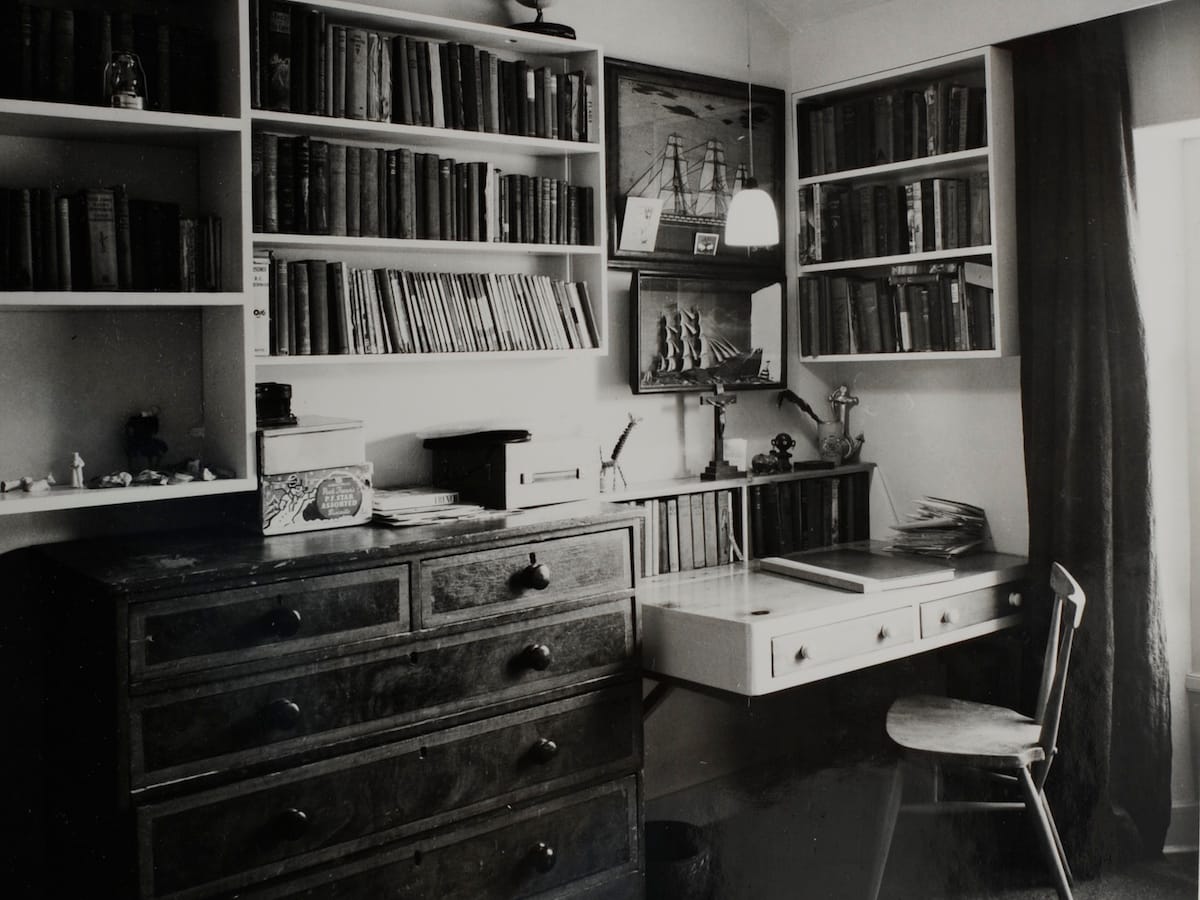
That desk really did change my life.
It was 1990. I’d scored a D, an N and a U in my A-level mocks. My chances of going to university were slender.
Then something wonderful happened. My grandfather gave me the use of the room you can see in the photograph. And, more importantly, he gave me the use of that desk, which he had made in the 1950s or 1960s.
There was one problem. Normally highly eccentric, he was also, at that point, unwell. Recently widowed, his doctor had put him on powerful, old-school antidepressants. He was convinced that people were trying to steal his typescripts. He sent large envelopes to the GP’s surgery adorned with dancing stick men and the legend:
MAN ON PILLS
It was hugely concerning, but there were compensations. Whenever I broke off my studies to pour myself a glass of (his) whisky, he would waylay me on the stairs and give me a lecture on Truth, Beauty and Justice. When I finally returned with my Scotch, he’d explain he’d been thinking further and would say something like:
‘The fantasy behind the reality, is the true reality.’
In short, not only did I have a space in which to learn, I had an unvarnished insight into another human being’s psyche. Not even Chaucer could offer that.
So, I aced my A-levels, won the second year arts prize and turned down my place at Glasgow University. A few months later, I accepted an unconditional offer from the University of St Andrews where, in my first class test, Robert Crawford complimented me on having ‘the makings of a clear, sharp writer.’
Why am I telling you all this?
One of the reasons my clients like working with me is that I see things differently.
If I didn’t, this page would be chock full of relevant, if somewhat boring information about my career. I can see it now: learned to read at the age of three… won the Penmanship Prize at primary school in 1985… graduated 1997… qualified as a teacher 1998… Assistant Editor at Family History Monthly 1998-2000… worked for educational charities 2000-2006… became a freelance copywriter in 2006… co-founded the Professional Copywriters’ Network in 2012… branched out into content consultancy in the 2020s…
In other words, you’d discover that I was moderately bright and could write. Two things you’d rather expect from any copy specialist.
In my view, what really makes a good writer and judge of good writing is not simply verbal deftness, but insight into other people. You need to know what interests them and motivates them, what keeps them awake at night, what makes them feel safe or special, and what would make them trust you.
And to get that, you need a much broader set of experiences than the classic education, career, awards and achievements arc.
That’s why, when you work with me, you benefit from the experience of someone who has:
- Lived on council estates, in modest private homes and a palace
- Been educated in state schools, won a scholarship to a a public one, and later ditched it in favour of the local FE college
- Worked in a wool-baling factory and petrol station; as a road sweeper, forester and care assistant; as a third sector project manager; and as researcher and writer
- Studied English Lit, Practical Theology and Scottish History at St Andrews University before graduating with an MA (Hons) in Mediæval History (while there, I improbably played tiddlywinks at a competitive level)
- Trained as a secondary school history teacher at UEA. I have a reference from a mentor that says I am a ‘fine caring teacher of history’
- Never pursued a journalistic career, but has contributed to The Guardian and The Times, and appeared on BBC Radio 4’s The Moral Maze
- Spent a year as an elected borough councillor and accidentally ended up in the Daily Mail (I don’t do politics these days)
- Learned enough French to read novels and play charades with locals outside bars, and just about enough German to read children’s stories – though I did once pick my way through Ferdinand von Schirach’s Schuld
Of course, none of this is a substitute for knowing how to do the job.
The job, ultimately, is people. Understanding what they want, what they fear, what they’ll act on – and then finding the words that get through. Writing skill is just one part of that.
And perhaps that is why I keep coming back to that desk.
Not because it made me a writer. It didn’t. It gave me an unobstructed view into another human mind.
Still here? Good.
That probably means you don’t want vanilla, committee-approved corporate prose.
You want something sharper.