Manticore: stop paying for a website that doesn’t do its job

Before you spend another pound on it, find out what your website is actually doing
Your firm has published a great deal of content over the years. Service pages, articles, guides, news items, campaign pages that ran once and never got removed. Much of it may have been written by someone who has since left, for a reason nobody now remembers.
Then someone proposes a rebuild, a move to a new site, an SEO campaign or a run of new copy. The quote is substantial. And nobody in the room can say which of the existing pages are worth the money.
That’s the decision Manticore exists to inform.
The problem is the sheer number of pages
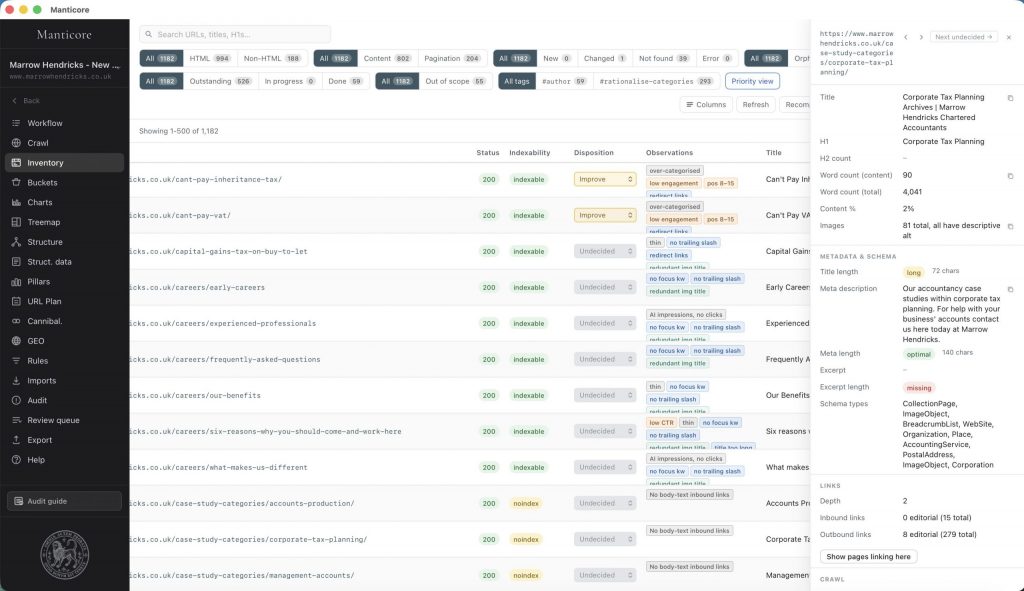
If your website has thirty pages, it’s easy for someone to read them all and decide on a plan. If it has a thousand, that is weeks of work before a single recommendation is made – and most firms are unwilling to pay for it.
So the usual compromise is to look closely at a sample and make assumptions about the rest. That may be the right commercial choice. It does mean the decisions about most of your website rest on inference rather than evidence, and that the reasoning behind each one may not survive to the point where the work is actually done.
Manticore is software I built to close that gap. It examines every page within the agreed scope, applies the same checks to all of them, and keeps a record of the evidence behind each recommendation – so that six months later, when your developer asks why page 604 is on the delete list, there is an answer.
What it costs you to get this wrong
You pay to move pages nobody needs. When nobody decides what stays, everything stays. Dead campaign pages and three articles saying the same thing arrive on the new site in a smart new design, faults and all. You pay to rebuild them, then you pay someone to read them again later.
You delete pages that are still bringing in work. A dated-looking article can be the reason a certain kind of client finds you. Take it down without checking and you close that door without ever knowing it was open.
You commission copy you don’t need. The fault is rarely too few words. More often nothing on the site links to a service page you want people to reach, or four pages fight over the same subject. Another article will not fix either problem.
What the software does
Manticore reads every page within the agreed scope and gathers what is known about each one: what links to it from elsewhere on your site, what it links to, when it was last changed, and which other pages appear to cover the same ground. Where you have Google Search Console, Google Analytics and Semrush data, it adds what those show about how people find the page and whether they stay.
It then sorts thousands of individual observations into a workable number of decisions, grouped page by page. That is the useful part. Finding faults on a large website is not difficult. Presenting them in a form your marketing team can act on is.
It also says how far each finding can be trusted: whether it is a plain technical fact, a probable editorial fault, something a person has to read and judge, or a question only your firm can answer. Where it cannot establish something cleanly, it says so rather than guessing.
What the software cannot do
Manticore cannot know that a page with almost no traffic brought in a significant instruction. It cannot know that an old article still matters to your regulator. It cannot know which part of the practice the partners intend to grow.
So it does not try. The software observes and records. I read the evidence, weigh it against what the page is for, and make the recommendation. You decide whether to act on it.
That division is deliberate and it does not move. A recommendation nobody can explain is worth very little in a partners’ meeting.
What you receive
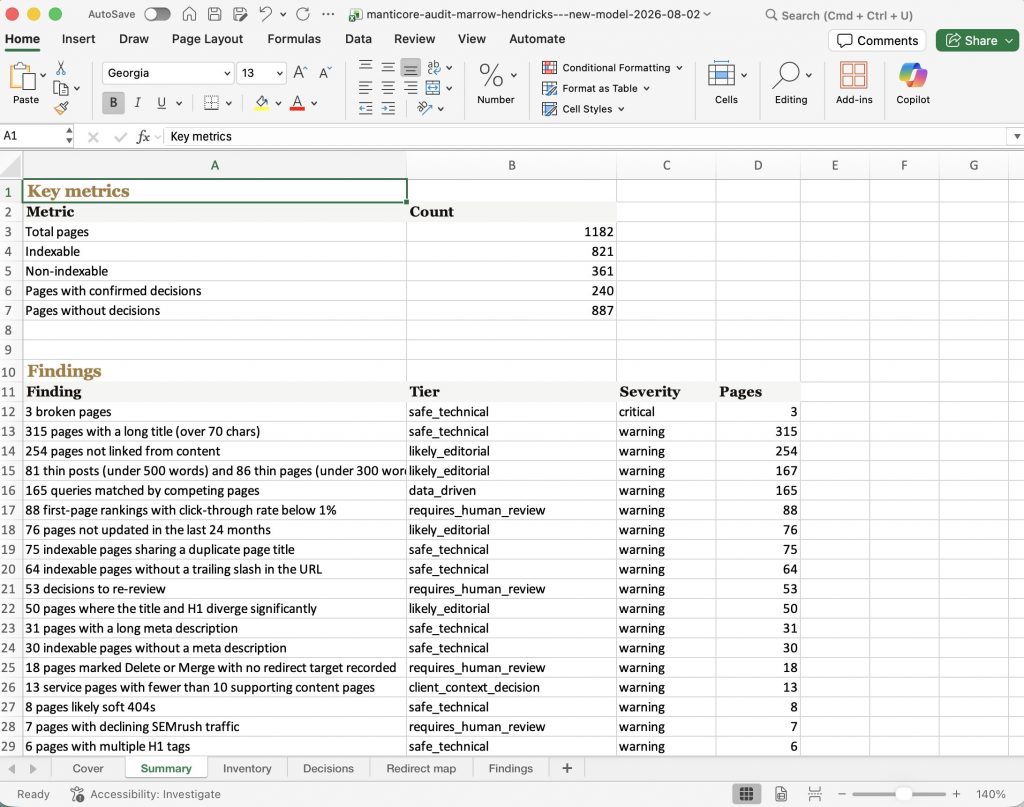
We agree the outputs before I start. Depending on scope, you will get:
- A decision on every page examined – keep, improve, merge, archive, delete, or leave outside the project
- The reason for each one, so it still makes sense when the work starts months later
- An order of play: what matters now, what can wait, what is not worth doing
- A list for your developer: old address, intended destination, action required
- A sheet for your writers: which page, what to do with it, what the evidence says, and what to fold into it
- A plan of the site: which pages matter most, what should support them, where the links are missing
- A workbook holding the whole audit, in a form your team can sort and use
On longer jobs I send interim reports so you can see what is settled and what still needs your input.
What it can tell you about your firm
An audit is not only a tidying exercise. The same evidence that decides what happens to each page also answers questions the partners have probably been arguing about without data.
- Which parts of the practice take up most of the website and draw the least attention
- Where a service that matters commercially is barely explained
- Whether your best-read articles lead anyone towards the work you want
- Pages found through search often enough that deleting them would be a gamble
- Subjects covered so many times that consolidating them is worth considering
- Whether your content is clear enough for AI to recommend you
- Gaps: questions your clients ask that the site never answers
The answers can change the scope of a rebuild and what your copy budget is spent on.
When it is worth doing
An audit earns its fee when the site has grown past the point where anyone can hold it in their head. That usually means one of the following applies:
- A rebuild or a move to a new website is coming
- Years of articles and service pages have piled up
- Several offices or departments have published without one plan between them
- The blog brings visitors but few enquiries
- You want a smaller site and cannot afford to lose the traffic
- Marketing, SEO and development need to work from the same decisions
It need not cover the whole site. It can take the blog, one practice area, or just the pages caught up in a move.
Manticore is intended for larger or more complex websites. If you need a smaller review, a blog audit or help defining the problem first, see my broader content audit services.
Why I built Manticore
I have written for professional firms since 2006 and, when I later began to undertake content audits, they kept hitting the same wall. The evidence needed to decide well existed, but nothing I could find assembled it in a form a person could act on. The tools I tried either produced technical warnings nobody could turn into a plan, or made editorial judgements that had to be unpicked before they were any use.
So I built what I needed. It was written for one job, on real professional services websites, by the person who then has to defend the recommendations to the client.
It is not for sale and I am not planning to sell it. It exists because the audits I deliver with it are better than the ones I could deliver without it.
What hiring me involves
We agree what decision the audit has to support, which pages it covers, and what your team needs at the end. You supply the exports you have and the commercial knowledge that is not in any of them.
I run the audit, examine what it finds, and make a recommendation for every page in scope. You get the decisions, the reasons, the priorities and the documents your people need to act.
You are hiring me to carry out and interpret the audit, not buying access to software. Manticore supplies the consistency and the record. I supply the judgement.
Practical questions
Questions people ask
A few things worth knowing before we start.
Can I buy Manticore?
No.
I built it for my own audits. It is not sold, licensed or offered as a subscription.
The only way to commission a Manticore audit is to hire me.
Does the software decide what happens to our pages?
No.
It gathers evidence and highlights patterns. I make the recommendation in context.
Your firm approves the action.
Do you need access to the back of our website?
Usually not.
Most of the work runs from the public site and the exports we agree.
A WordPress export tells me a great deal without giving me a standing key to your site.
What data can you use?
Whatever you have that helps: the crawl itself, a WordPress export, Google Search Console, your analytics and outside search figures.
Thin data will not stop an audit. Good data sharpens it.
What do we receive at the end?
We agree that at the start.
It can include a findings report, a list of every page with the decision and reason for each, priorities, sheets for the writers, a list for the developer, a proposed site structure and a working workbook.
Finished copy or a full writing brief is separate work.
If you are approaching a rebuild, migration, SEO investment or a substantial content project, send me a link to your website and tell me what you are trying to decide. I will tell you whether an audit will help and what it should cover.